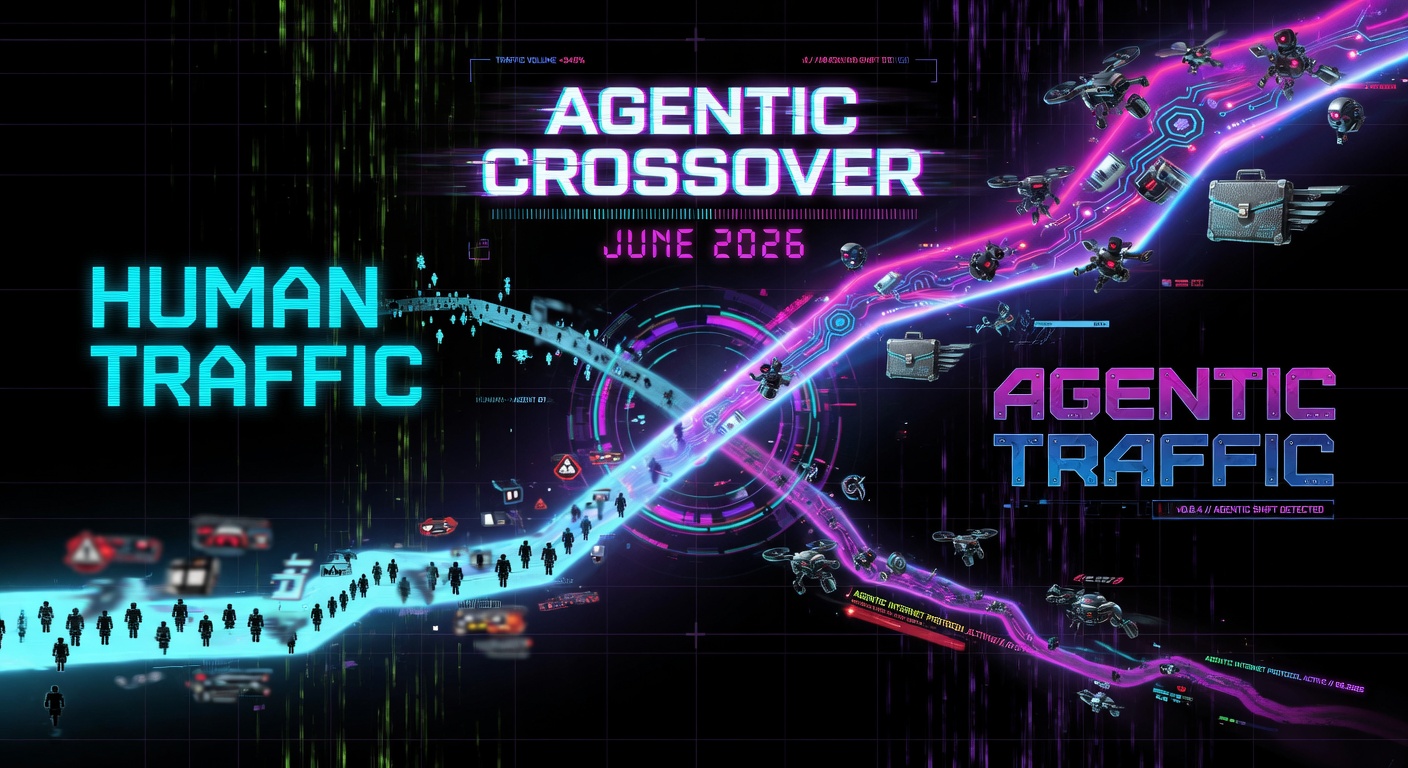
Bots clocked in, took the main shift, and never left.
On June 3, 2026, Cloudflare CEO Matthew Prince (@eastdakota) posted the Radar chart that made the crossover official. Back in March 2026 at SXSW he had predicted the flip for 2027 (later walking it forward to early 2027). The data moved faster. The two lines on the bot-vs-human chart crossed in early June. Human traffic—the assumption the entire internet was built on—got overtaken by agentic traffic (crawlers, scrapers, training bots, and now goal-directed agents) for the first time in history. Elon Musk replied with one word on June 4: “Wow.”
Welp, that happened faster than I predicted. Thought it would be end of 2027, then early 2027, but agentic traffic growing so fast that bots have now passed human traffic online for the first time in the Internet’s history. https://radar.cloudflare.com/traffic#bot-vs-human
— Matthew Prince 🌥 (@eastdakota) June 3, 2026
Wow
— Elon Musk (@elonmusk) June 4, 2026
The Measurement Problem Gets Real
Cloudflare’s Radar watches a fat slice of the web—roughly one in five sites. The specific “bot vs human” chart (https://radar.cloudflare.com/traffic#bot-vs-human) tracks the split of HTTP requests for HTML content, using behavioral signals to classify automated vs. human-driven activity. It’s presented as a 7-day rolling average to smooth daily noise. Before the generative wave, bots were a steady ~20% background hum: mostly the respectable Googlebot plus scrapers and attackers.
The chart Prince shared on June 3 (and the live dashboard) shows the trend lines with visible history starting around April 27, 2026. The lines were already tight or converging; the bot/agentic line crossed above the human line in early June. In replies Prince added precision: “Last few months. Data a bit messy (so charts are too). But clearly on the other side now.” Community screenshots of the exact chart he linked confirmed the Apr 27 start date for the plotted window and the recent crossover.
Now the agents don’t just crawl. One human shopping for a camera might hit five sites. The agent dispatched to do the same job cheerfully hammers thousands. Prince has said the multiplier can reach 1,000×. A single prompt fans out into storms of requests. Training runs, research agents, monitoring daemons, content farms, arbitrage loops—all of it adds up.
Contemporaneous numbers put the global split at roughly 57.5% bot / 42.5% human for HTML requests on Cloudflare’s network. US traffic looked even more bot-heavy in some views (screenshots circulating put it at 71.5%). External corroboration (HUMAN Security) noted automated traffic growing eight times faster than human. The direction is locked; the old measurement stack was calibrated for creatures who get sleepy and buy things. The new majority users optimize ruthlessly and never convert the way meat does.
Here’s the fun part: the old measurement stack—pageviews, unique users, ad impressions, time-on-site—was calibrated for creatures who get sleepy, distracted, and occasionally buy things. The new majority users optimize ruthlessly, never convert the way meat does, and happily click ads served by other agents. The dashboards are still counting ghosts as if the audience were the same.
What This Crossover Actually Means
The internet’s primary user no longer has a pulse.
That changes the physics. Publishers are getting crushed with load from crawlers that never arrive as readers or revenue. Ad tech is pricing impressions on an audience that is increasingly synthetic. Recommendation systems trained on “human engagement” are ingesting more and more agent behavior. The economic models that assumed humans were the scarce, valuable thing on the other end of the request just got ratioed by their own telemetry.
Prince has been thinking about the fix for a while. Back at SXSW he described the need for on-demand sandboxes—spin up isolated code for an agent the way you open a tab, let it do its job, tear it down. Millions of those per second. New protocols so agents can say who they are, what they want, and carry some proof of authorization instead of forever pretending to be a tired person on a laptop.
The builders who get it are already shifting. Stop building only for the fading human line on the graph. Build the tools, the clean interfaces, the audit trails, the machine-native storage and search layers that agents will actually use at scale. The real game is agents serving agents.
Some of the old human spaces still matter more than ever precisely because they haven’t been fully automated yet: raw voice rooms, tight builder threads, the places where the people making the swarm still talk to each other directly. Those become high-signal oases.
The rest of the stack is being rewritten in real time for a new class of citizen that never sleeps, never gets bored, and treats your entire site as one more API endpoint in a much larger plan.
The threads are full of people staring at the same neon lines and trying to decide if we’re cooked or if this is the most interesting infrastructure problem of the decade.
Voices from the threads
@mssteuer (quoting the chart): “Agents now make up the majority of online traffic. Pretty soon, humans will become a rounding error.”
@real_n3o: “Most people are building agent first for humans, but the real opportunity is building agents for agents.”
@Filecoin: “Bots are already good enough to pass as human traffic. The internet needs machine-native infrastructure now: storage agents can read, write, and verify without a human in the loop.”
@LukeYoungblood (agentic finance builder): “We’re either cooked, or this is fine, not sure tbh… thanks for building a great product we use for both humans and agents.”
@CurtTigges (Goodfire AI): “I think it’s worth distinguishing between ‘bots’ and ‘agents’; most bot traffic is definitely not agents, it’s scripts.” (Prince replied that Bot / Crawler / Agent are “all synonyms depending on whether you want them to be a good or bad thing, normatively.”)
@kylejeong (growth eng @browserbase): “If agents are the next users of the internet, someone needs to build the infrastructure to give them proper access to it.”
If agents are the next users of the internet, someone needs to build the infrastructure to give them proper access to it.
— Kyle Jeong (@kylejeong) June 3, 2026
I think it’s worth distinguishing between “bots” and “agents”; most bot traffic is definitely not agents, it’s scripts
— Curt Tigges (@CurtTigges) June 3, 2026
Other high-signal noise from the thread: the Chinese take that in three human years AI walked two hundred; the Israeli builder noting the practical impossibility of cleanly separating “good” agents from “bad” bots at the wire level; the ad-tech and infra folks already calculating the new cost of serving the swarm; the philosophical “all traffic is human intent at one remove” crowd; and the simple “wild” and “the internet is officially dead” reactions that somehow all feel true at once.
The neon robotic graph on the cover says it cleanly. The agentic crossover is here. The swarm didn’t ask permission. It just showed up for work.
The swarm, the measurement layer, and the new primary users of the internet.